EN 13432 is considered the European “gold standard” for determining whether packaging truly biodegrades completely and is environmentally safe. As demand for green packaging continues to rise, businesses that understand and apply EN 13432 gain a significant advantage in meeting international market requirements and strengthening brand credibility.
What Is EN 13432?
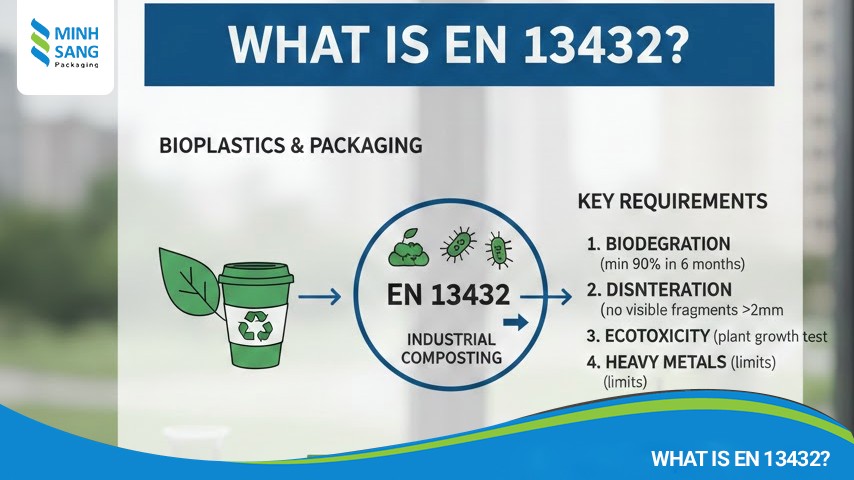
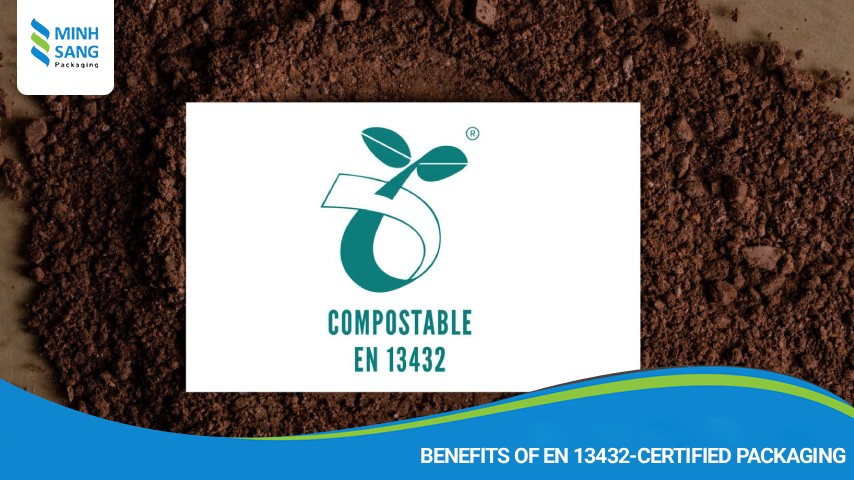
EN 13432 is a European standard that defines technical requirements for determining whether packaging or products are biodegradable and compostable. This standard ensures that packaging not only breaks down physically but also fully biodegrades, leaving no toxic residues or microplastics that could harm the environment.
Purpose of the EN 13432 Standard
The primary objective of EN 13432 is to ensure that so-called “green” packaging products on the market are genuinely environmentally friendly. It helps clearly distinguish truly compostable packaging from products that are merely “greenwashed,” thereby protecting consumers and encouraging businesses to adopt sustainable packaging practices.
Key Requirements to Achieve EN 13432 Certification
To be certified under EN 13432, packaging must meet a series of strict criteria designed to guarantee complete biodegradation without environmental harm at any stage:
-
Biodegradation: At least 90% of the material must biodegrade within 6 months, converting into CO₂, water, and biomass rather than simply fragmenting.
-
Disintegration: The packaging must break down into small fragments within 12 weeks under industrial composting conditions, ensuring rapid physical disintegration.
-
Non-toxicity: The material must not contain harmful substances or negatively affect soil quality or plant growth after decomposition.
-
Heavy metal limits: Heavy metal content must remain within strict European safety thresholds to prevent soil contamination.
-
Compost quality: After decomposition, the material must not interfere with the composting process or reduce the quality of the resulting compost.
Benefits of EN 13432-Certified Packaging
When packaging meets EN 13432 standards, both businesses and consumers gain significant advantages:
-
Environmental safety assurance: Fully biodegradable packaging that leaves no microplastics or toxic residues.
-
Enhanced brand credibility: Builds trust with customers through a clear commitment to sustainability.
-
Regulatory compliance: Simplifies adherence to strict European and other international environmental regulations.
-
Export facilitation: Internationally certified packaging is favored in global markets.
-
Reduced environmental impact: Used packaging can be transformed into valuable compost.
-
Support for the circular economy: Minimizes waste while regenerating material value after use.
EN 13432 Certification Process
To obtain EN 13432 certification, packaging materials must undergo a rigorous, multi-step evaluation process conducted by independent testing bodies.
Chemical Composition Assessment
The first step involves analyzing the chemical composition to measure organic carbon content, heavy metal levels, and potentially toxic substances. Any parameter exceeding European limits disqualifies the product from further testing.
Biodegradability Testing
The material is placed in standardized industrial composting conditions. Within 180 days, at least 90% of the material must biodegrade into CO₂, water, and biomass—this is the most critical requirement of EN 13432.
Physical Disintegration Testing
Next, the material is composted for 12 weeks and then screened. The packaging must disintegrate into fragments so small that they are no longer distinguishable by the naked eye, proving complete physical breakdown.
Ecotoxicity Testing on Soil and Plants
After decomposition, the resulting compost is used for plant growth tests. The material is considered safe only if plants grow normally without discoloration, reduced yield, or toxic effects.
EN 13432 Compared with Other International Standards
EN 13432 is one of the most important compostability standards and is often compared with other global benchmarks:
-
ASTM D6400 (USA): Evaluates biodegradation and compostability under industrial composting conditions in the United States.
-
ISO 17088 (International): Provides global requirements for compostable plastics in industrial composting systems.
-
AS 4736 (Australia): Australia’s national standard for biodegradable plastics suitable for composting environments.
Common Packaging Products Certified Under EN 13432
Many green packaging products are designed to meet the strict compostability requirements of EN 13432. These materials align well with sustainable consumption trends in Europe and other developed markets:
-
Compostable bags made from PLA or starch: Produced from renewable resources such as corn, sugarcane, or cassava; fully compostable in industrial facilities.
-
Biodegradable trash bags: Widely used in households, restaurants, hotels, and hospitals; decompose rapidly without leaving microplastics.
-
Biodegradable films (biofilms): Used for food wrapping and small-item packaging; made from PLA, PHA, or blended biopolymers.
-
Biodegradable cutlery and food containers: Single-use products made from PLA, PBS, or wood fiber; common in F&B, takeaway coffee, and large events.
-
Compostable food packaging and laminated films: Suitable for snacks, instant noodles, fresh-cut fruits, and frozen foods.
-
Biodegradable labels and stickers: Thin labels made from PLA or cellulose that meet compostability criteria, enabling fully green packaging systems.
The Role of EN 13432 in Green Packaging Trends (2026–2030)
The period from 2026 to 2030 is expected to be a major growth phase for green packaging as consumers, governments, and businesses prioritize sustainability. In this context, EN 13432 serves as a core benchmark to distinguish genuinely eco-friendly packaging from marketing-driven claims.
-
Helps identify truly compostable packaging and prevent greenwashing
-
Provides transparent criteria for complete biodegradation under industrial conditions
-
Supports business expansion into highly regulated markets such as Europe
-
Encourages R&D in advanced biopolymer materials
-
Strengthens consumer trust in sustainable products
-
Guides green packaging development trends from 2026 to 2030
Conclusion
EN 13432 is the gold standard for identifying packaging that is fully biodegradable and environmentally safe. As green packaging trends accelerate between 2026 and 2030, compliance with this standard becomes a critical competitive advantage for businesses seeking credibility and access to demanding international markets. If you are looking for high-quality, internationally certified green packaging, Minh Sang Packaging is ready to support your sustainability journey.